Voice of Greece: July 30, 2013
/
The following is a recording of the Voice of Greece (9,420 kHz) made on July 30, 2013, beginning around 20:11 UTC. Enjoy:
The following is a recording of the Voice of Greece (9,420 kHz) made on July 30, 2013, beginning around 20:11 UTC. Enjoy:
Earlier this week, I noted that Cuban medium wave station, Radio Progreso, was to begin broadcasting on 4,765 kHz shortwave, beginning October 1st at 00:30 UTC.
I listened between 00:30 and 2:30 UTC on Oct 1st, but heard nothing other than the weak carrier from (possibly) Radio Emissora De Educao Rural. However, the following evening at 01:00 UTC (October 2nd) I did hear a strong signal from Radio Progreso.
For your listening pleasure: the recording I made of Radio Progreso on October 2, 2013, starting around 01:00 UTC. Click here to download the recording as an MP3 or simply listen via the embedded player below:
Many thanks to SWAA contributor, Hans de Zeeuw, for this short recording of The Voice of Indonesia radio in English.
Recorded in Scotland on the 21st of January, 2013, on 9,526 kHz, starting at 17:31 UTC. Hans uses a Microtelecom Perseus receiver and a Wellbrook ALA 1530 antenna.
Click here to download the recording as an MP3, or simply listen via the embedded player below:
Sunday afternoon--one week ago--I was at home to catch a bit of the GAA finals via RTÉ on 17,725 kHz, starting around 15:00 UTC.
I enjoy hearing sporting events broadcast over shortwave–perhaps it’s my imagination filling in the gaps from the live coverage or the washy sound of the crowds roaring. Regardless, RTÉ has a long-standing track record of broadcasting the GAA finals on every medium possible.
As I listened to the live broadcast, Sunday, I read Norman Freeman’s account of listening to the GAA finals from a ship in the Indian Ocean, back in 1956. He writes:
“Almost 50 years ago, listening to the All-Ireland by radio was uncertain and frustrating.
In 1956, RTÉ knew how much the All-Ireland meant to the Irish diaspora. Arrangements were made with the authorities in the then French Congo to have the match rebroadcast the following evening, on the powerful short-wave transmitter in Brazzaville.
The time and frequencies were published in the Irish newspapers. This information was sent by letter to the Irish on oil rigs off the coast of Borneo, to round-the-year painters on Brooklyn Bridge, and to missionaries within sight of Mount Kilimanjaro.
I had noted the time and frequencies before I was sent out to Mumbai to join my first ship, the Amra, as second radio officer. The hurling final was between two giants, Cork and Wexford.”
[Continue reading...]
While Freeman doesn’t miss the uncertainty and fickle nature of shortwave radio as the messenger of his favorite sporting event, his look back is certainly nostalgic. After all, Radio Brazzaville transported Freeman and his boss back to Ireland for the length of the game. And to RTÉ’s credit, they continue to broadcast to the Irish diaspora on shortwave radio, if only for this event.
If you would like to hear my recording of the GAA Finals, click here to download the MP3 recording, or simply listen via the embedded player below:
I tuned in Europirate Radio Borderhunter on 15,500 kHz AM, starting around 21:50 UTC on September, 21 2013. For an AM signal out of Europe to make it to the east coast of the US, I was most impressed with Radio Borderhunter's strong signal.
I recorded about forty minutes of the pirate's broadcast before propagation shifted. He then moved down to 6,210 kHz in the 48 meter band, a prime Europirate hangout, to continue his show.
Click here to download the recording as an MP3, or simply listen via the embedded player below:
Many thanks to SWAA contributor, Frank, for this recording of IRRS radio in English. Recorded in Europe on the 14th of September, 2013, on 9,510 kHz, starting at 08:00 UTC. This broadcast emanated from the IRRS transmitter in Bucharest, Romania, Europe, at a power of 150 kW. The recording includes, inter alia, UN Radio programme.
Click here to download the recording as an MP3, or simply listen via the embedded player below:
Syria is one of the biggest international news items at the moment. If you want to hear Russia’s side of the story, there’s no better place than via the Voice of Russia.
Many thanks to Frank for submitting this recording of the Voice of Russia English language service. Frank recorded this broadcast on September 14, 2013 starting at 22:00 on 9,465 kHz with his Kenwood R-5000 receiver.
Click here to download an MP3 of the broadcast, or simply listen via the embedded player below:
The BBC World Service English language service recorded on 9,735 kHz on September 14, 2013, starting at 15:00 UTC. This BBC WS broadcast originated from a 100 kW transmitter located at the Tashkent transmitter site, in Uzbekistan, Asia.
Click here to download the recording as an MP3, or simply listen via the embedded player below:
Many thanks to SWAA contributor, Frank, for this recording.
Many thanks to SWAA contributor, Frank, for this recording of China Radio International's (CRI) English Service.
Recorded on 17,490 kHz on September 13, 2013, starting at 07:00 UTC. This CRI broadcast originated from a 500 kW transmitter located at the Kashi transmitter site in China.
Click here to download the recording as an MP3, or simply listen via the embedded player below:
Many thanks to SWAA contributor, Frank, for this three hour recording of the Voice of Greece.
Recorded in Europe on September, 12 2013 starting at 05:00 UTC on 11,645 kHz.
Click here to download the recording as an MP3, or simply listen via the embedded player below:
Ayutthaya, Thailand (Source: Wikimedia Commons)
Many thanks to SWAA contributor, Frank, for this recording of Radio Thailand World Service.
Recorded in Europe on September, 13 2013 starting at 19:00 UTC on 9,390 kHz.
Click here to download the recording as an MP3, or simply listen via the embedded player below:
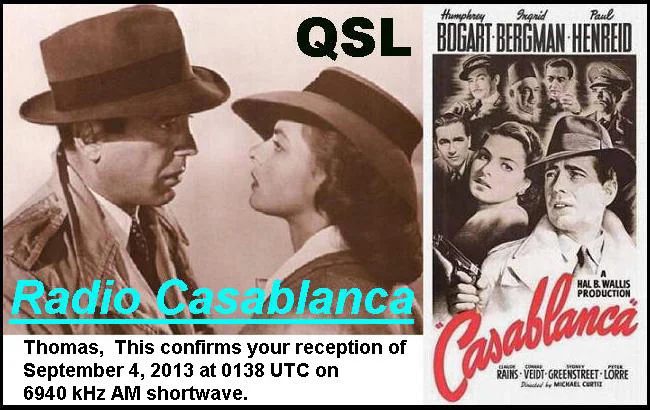
Confession time: one of my favorite pirate radio stations is Radio Casablanca.
Why?
For one thing the format is WWII-era music. When I hear Radio Casablanca, I close my eyes and imagine what it must have been like to hear the great bands of the era over the shortwaves...
Radio nostalgia at its best.
The signal strength is always sufficient to be heard in relatively good fidelity here in my radio room, but not so strong as to detract from the perceived distance. I believe the recording you'll hear below could very well mimic broadcasts over shortwave, heard across borders during WWII as well as listened to on classic console radios in people's living rooms and front parlors.
When my buddy Mark Coady posted that he was listening to Radio Casablanca last night on 6940 kHz AM, I immediately rushed outside to hook up my antenna, and started rolling. I didn't want to miss even one more minute (I came across Mark's post about twenty minutes into the broadcast). Though regional storms produced some static pops and crashes, overall fidelity is decent. You will hear the filter and side-band sync being adjusted at times as I attempted to eliminate adjacent noises--which, in the end, are all a part of the listening experience.
Click here to download an MP3 of the recording, or simply listen via the embedded player below. Either way, prepare to go (or at least, send your ears) back in time...
For your listening pleasure: a recording of the Deutsche Welle English service made this morning, September 3rd, starting at 04:00 UTC.
Click here to download the recording as an MP3, or simply listen via the embedded player below (note about 40 seconds of carrier prior to the beginning of the broadcast):
Lately, the Voice of Greece has been playing very long sets of music; and not all of it Greek. I assume the break in format has to do with the reorganization of Greek national broadcasting.
I believe VoG could be cut on a moment's notice. With heavy cuts being dealt to national broadcasting, I doubt they'll keep investing in shortwave radio since they no longer even have an English language service. This is one of the reasons I've devoted a lot of recording time to VoG as of late.
I certainly hope I'm wrong about my prediction.
On September 1st, I recorded over five hours of VoG, starting around 22:00 UTC. After about an hour of Greek commentary, you'll hear music ranging from contemporary to classical.
Click here to download the full recording as an MP3, or simply listen via the embedded player below.
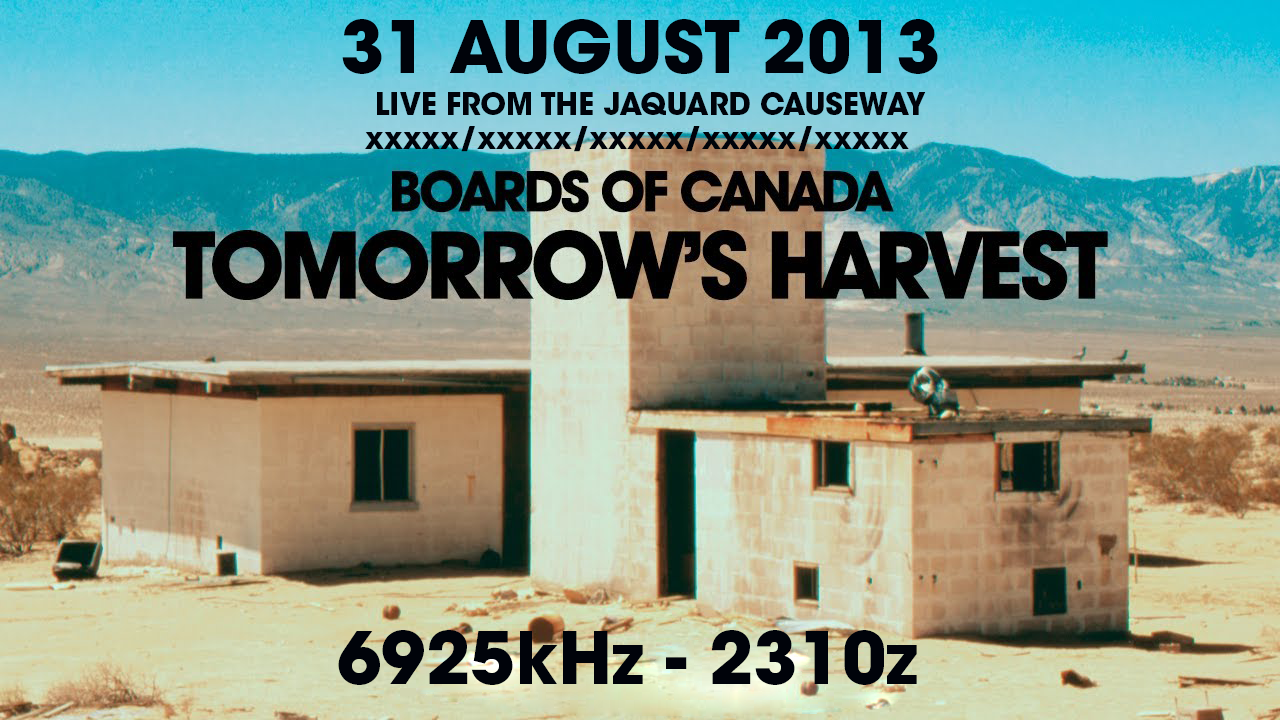
Friday night (30 August 2013), I came across a new shortwave pirate radio station: BOCHF.
BOCHF started broadcasting around 23:10 UTC on 6,925 kHz USB, and after about a twenty-five minute set, took a five minute break, then returned with a forty-two minute set, ending with an SSTV QSL. The signal, as you can hear below, is fairly strong, but interference was also strong at times; especially from SSB pescadores (fishermen) and the usual summer static crashes.
The entire mix consisted of Boards of Canada music from Tomorrow’s Harvest. There were no vocal ID’s, but there were messages in CW (Morse code) which clearly identifies this pirate as BOCHF.
The artists Boards of Canada have always had an affinity with shortwave radio, so I find a shortwave pirate station playing their music to be an appropriate tribute. Due to sound card problems, I was unable to decode the SSTV QSL, but thankfully a great copy was posted on HF Underground’s pirate radio forum (see above) by forum contributor, Chris Smolinski.
Click here to download MP3s of Part One and Part Two from the full broadcast last night or simply listen via the embedded audio players below:
Again this morning (1 September 2013) at 2:20 UTC–and last night, during a very active night of pirate radio activity–BOCHF crept onto the airwaves, this time on 6,920 kHz USB.
Yesterday, BOCHF played the Boards of Canada album Tomorrow’s Harvest; this morning, they played their album In a Beautiful Place Out in the Country.
And how did it sound? Combining the music of the Boards of Canada with the sonic texture of the shortwave ether is a winning combination, in my opinion. But don’t take my word for it: take a listen yourself.
Click here to download the full broadcast as an MP3, or simply listen via the embedded player below:
BOCHF also sent me this hi-resolution QSL card (below) after hearing the off-air recordings.
Many thanks, BOCHF!
As on many Saturdays, this morning, I sipped my coffee while listening to ABC’s Saturday Night Country from Radio Australia’s Shepparton shortwave transmission site on 9.58 MHz…some 9,800 miles from my home.
In this program, Catherin Britt continues to fill in for Felicity Urquhart (who is on maternity leave).
I captured a two hour broadcast which you can download by clicking here or simply listening via the embedded player below.

For your listening pleasure: a recording of the Voice of Greece made Tuesday night, August 20th, starting at 23:00 UTC.
This broadcast begins with my favorite Voice of Greece station ID, then, following a little Greek commentary, resumes with an eclectic mix of music.
This is one of the few broadcasts I've heard with a substantial dose of non-Greek music. Click here to download the full recording as an MP3, or simply listen via the embedded player below:
Also published on The SWLing Post:
Many afternoons, I'm drawn to All India Radio on 9,445 kHz. I love what the ether does to their Bengaluru transmitting station's signal as it travels at the speed of light over 8,700 miles to my home here in the southeastern US.
Pressing hands together with a smile to greet Namaste/Namaskar – a common cultural practice in India. (Source: Wikimedia Commons)
I enjoy, too, the way All India Radio announcers speak the news, in slow cadence, honoring the fine tradition of radio: "This is the general overseas service of All India Radio. It's time now for the news. Please stand by..." I also delight in their English language news bulletins, which begin with "Namaskar." I appreciate this--it makes it much easier for me to identify the station when listening on an analog radio like my BC-348-Q. I'm sure this makes a difference for many other listeners seeking their station, too.
I also love All India Radio--like I do the Voice of Greece--for their superb music. Where else on the shortwave dial will I hear the sitar sing, as on AIR?
But don't take my word for it. If you live in North America and Europe, when conditions are favorable, All India Radio is a favorite listening experience for many--myself obviously included.
For your listening enjoyment, here is a 30 minute recording I made of All India Radio only an hour ago on 9,445 kHz, starting at 22:00 UTC. Click here to download the recording as an MP3, or simply listen via the embedded player below:
For your listening pleasure: a thirty minute show of Voice of America's French service to Africa. Recorded August 13, 2013 on 9.885 MHz starting at 21:00 UTC.
Click here to download the recording as an MP3, or simply listen via the embedded player below:
[Note: I originally posted this article, along with the recording, on The SWLing Post]
While I'm passionate about shortwave radio--a technology that has, of course, been around for many decades--I also love to hear about emerging digital technologies, especially those that make our world a better place.
These days, I listen to several shows about technology, many of which are only available as a live stream or podcast (like TWIT, for example).
There are two shows, however, that I like to listen to on shortwave radio when my schedule allows.
One such show is the BBC World Service technology show, Click (formerly Digital Planet). I've listened to Click for years, and have even been interviewed on the show by its marvelous host Gareth Mitchell (click here to listen). I especially love the show's focus on technologies that have a positive impact in developing countries (hence my interview, about my non-profit, ETOW). Mitchell, I'm delighted to add, is quite the fan of shortwave radio as well, and is not afraid of reporting on technologies that are not exclusively tied to smart phones and the like.
Another show I've been listening to for a few months is Download This Show on Radio Australia. It's a fun and informative technology program and always has a great panel discussion on technology news. What I really love about this show is its take on Australian technology in particular, and how this compares with technology in the rest of the world.
Since Download This Show is broadcast via Radio Australia's Shepparton transmitting site, the signal is quite strong here in North America and easily received on portable shortwave radios.
Click here to download over two hours of Radio Australia, including Download this Show, or listen via the embedded player below. This broadcast was recorded on August 2, 2013, on 9,580 kHz, starting around 13:00 UTC.
You'll find Download This Show in the second hour of the recording, following the news headlines at 1:05.
The Shortwave Radio Audio Archive (SRAA) is a collection of shortwave radio recordings that you can download or listen to as a podcast. The collection grows every day and includes both historic recordings and current recordings from the shortwave radio spectrum.
The goal of this site is for shortwave radio enthusiast to have a place to store, archive and share their radio recordings with the world.
Click here to learn how to contribute and archive recordings.
Subscribe to the archive on iTunes,
You can subscribe to the archive with any podcasting application by subscribing to our RSS feed. Simply right click and copy this RSS feed url, then paste it into your podcasting application's subscribe box.