Radio Vanuatu in Bislama and English: March 6, 2015
/Radio Vanuatu received in Australia on the frequency of 3945 kHz. Music programming and sign off with national anthem at 1217 UTC. Transmitted at 10 kw from Port Vila.
Radio Vanuatu received in Australia on the frequency of 3945 kHz. Music programming and sign off with national anthem at 1217 UTC. Transmitted at 10 kw from Port Vila.
The following recording of Radio Ethiopia was made on November 17, 2008 on 9,704.18 kHz, beginning around 2040 UTC.
This off air recording comes from a collection of archived recordings by SWAA contributor, Terry Wilson.
Terry made this and all of his recordings in the Midwestern US on either the Ten-Tec RX-320D or Eton E1XM receivers. He used the recording facility of the Shortwave Log software. Terry notes that any "QRM includes city power lines, street lights with bad ballasts, household electronics, and interference from Radio Havana Cuba."
Many thanks for sharing these recordings, Terry! For more recordings from this collection, simply follow this tag: Terry Wilson.
You can listen to the full recording below, or download as an MP3 with the link provided.
For your listening pleasure: beHAVior Night, a shortwave radio show (relayed by WBCQ) dedicated to showcasing music from the first four decades of the 20th Century.
This show was recorded on 7,490 kHz, starting at 22:00 UTC on February 13, 2015.
I recorded Radio Santa Cruz early this morning around 05:00 UTC on 6,135 kHz using theTitanSDR I currently have under review.
Radio Santa Cruz‘s 10 kW signal from Santa Cruz, Bolivia, was very much audible here in North America, though RSC was competing with another station on-frequency at the time. Actually, Radio Santa Cruz was broadcasting slightly off-frequency–6134.8 kHz instead of 6,135 kHz. In this case, the fact that RSC was slightly below frequency helped me delineate the station’s audio from that of a competing station. Click here if you would like to read about how lower sideband synchronous detection was used to help overcome adjacent signal interference.
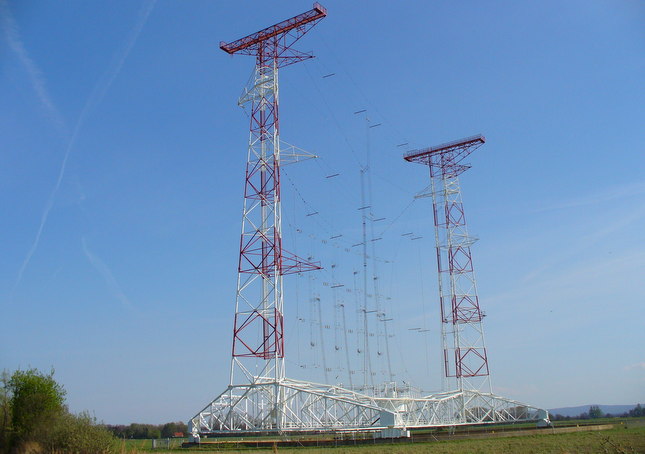
Rotating high performance directional antenna of the ORF (“Drehbare Hochleistungsrichtantenne ORF Moosbrunn“ von Daniel Csiky)
For your listening pleasure: Radio Österreich International.
This recording was made on 6,155 kHz on January 29, 2015 starting about 05:59 UTC.
Only recently, SWLing Post reader, Eric asked about orchestral music on shortwave–as you’ll hear, Radio Oesterreich International is certainly a good source!
Click here to download the recording as an MP3, or simply listen via the embedded player below. Enjoy:
This broadcast of All India Radio was recorded in eastern North America on January 26, 2015 beginning at 2145 UTC, shortwave frequency of 9,445 kHz.
This recording was made in eastern North America using a WinRadio Excalibur SDR connected to a large horizontal delta loop antenna.
For your listening pleasure: almost 2 hours of Helliniki Radiophonia (ERT Open). This broadcast was recorded on January 25, 2015 on 9420 kHz starting around 2200 UTC.
For your listening pleasure: beHAVior Night, a shortwave radio show which showcases music from the first four decades of the 20th Century.
This show was recorded on Friday, January 16, 2015, beginning at 2000 UTC on 7495 kHz:
It’s been a while now since 9,420 kHz–a former Voice of Greece frequency–should have gone off the air. Fortunately, it has not.
The station is no longer referred to as the Voice of Greece; it’s now a relay of ERT Open, otherwise known as the Helliniki Radiophonia (you’ll hear this name in the station ID).
January 2, 2015, I recorded nearly four hours of Helliniki Radiophonia starting around 2230 UTC.
Simply click here to download an MP3 of the full recording, or listen via the embedded player below.
The music begins, in earnest, a little after 17:00–enjoy:
For your listening pleasure: beHAVior Night, a shortwave radio show which showcases music from the first four decades of the 20th Century.
This show was recorded on Friday, November 28, 2014. While beHAVior Night is broadcast all year long via WBCQ, I’m not able to hear them easily at my home during Daylight Savings Time (DST) as the propagation path is not yet open to the south. During the winter months, however, the signal is quite strong as you will hear.
Click here to download the recording as an MP3, or simply listen via the embedded player below:
Sunday, October 18, 2014, I tuned to The Mighty KBC on 7,375 kHz, starting at 0000 UTC. The KBC signal out of Europe was blow-torch strength here in North America.
DJ "Uncle Eric" begins the music mix with one of my favorite songs by The Kinks: "Lola."
Click here to download the recording as an MP3, or simply listen via the embedded player below. Please subscribe to our podcast to receive future recordings automatically.
For your listening pleasure: 30 minutes of The Talking Machine Show via WWCR. This broadcast was recorded October 18, 2014 at 2300 UTC, on the shortwave frequency of 9350 kHz. This recording was made with an Elad FDM-S2 and sky loop wire antenna in North Carolina, USA.
Click here to download the recording as an MP3, or simply listen via the embedded player below. Please subscribe to our podcast to receive future recordings automatically.
Many thanks to SRAA contributor, Frank for this recording of Radio City Via IRRS (Italy).
This recording was made in Europe on October 11, 2014 at 08:00 UTC on 9.510 MHz.
Click here to download the recording as an MP3, or simply listen via the embedded player below. Please subscribe to our podcast to receive future recordings automatically.
Many thanks to SRAA contributor, Richard Langley, for this recording of PCJ International's Song of India. Richard notes:
Off-air recording of the initial broadcast of the program "Song of India," produced by PCJ Radio International and transmitted by WRMI, Radio Miami International, from its transmitter facilities at Okeechobee, Florida, on 5 October 2014 from 00:00 to 02:00 UTC on a shortwave frequency of 7570 kHz.
Richard also notes that reception quality is only fair as Hanwell, New Brunswick, Canada, is considerably off to the side of the transmitter beam direction.
Click here to download the recording as an MP3, or simply listen via the embedded player below. Please subscribe to our podcast to receive future recordings automatically.
The Andean range over the province of Santa Cruz. Image by Luca Galuzzi (Lucag) - Photo taken by Luca Galuzzi.
For your listening pleasure: the English language service of Radio Argentina Exterior--recorded on September 20, 2014 at 01:56 UTC on 11,711 kHz.
RAE is one of the more casual broadcasters on the air; I enjoy listening to their music selection and commentary as they're not quite as formatted as other international stations. This recording begins with RAE's interval signal--one of my favorites.
Click here to download the recording as an MP3, or simply listen via the embedded player below:
Sri Lanka as viewed from the International Space Station (source: NASA)
For your listening pleasure: forty three minutes of the Sri Lanka Broadcasting Corporation.
I recorded this broadcast of Sri Lanka BC around 01:15 UTC on Sept 11, 2014 on 11,905 kHz. Sri Lanka BC is not an easy broadcaster to receive in eastern North America, but band conditions on the 11th were particularly favorable in the higher bands. As you’ll hear in the recording, their 125 kW signal out of Trincomalee, Sri Lanka was reasonably strong; I used my WinRadio Excalibur receiver and external multi-band horizontal delta loop antenna.
Indeed, looking through the archives, this may be the first time I've recorded Sri Lanka BC.
Click here to download the full recording of Sri Lanka BC, or simply listen via the embedded player below:
[Source: SWLing Post]
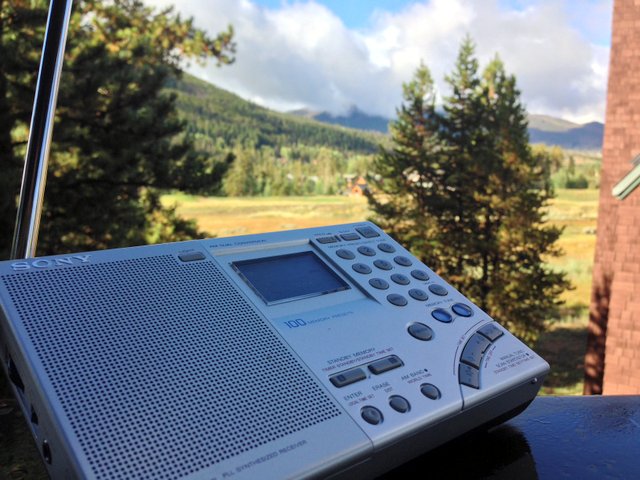
I’m in Keystone, Colorado at about 9,300′ (2,835 M) above sea level; mornings are crisp and chilly (38F/3C), but that doesn’t stop me from putting on a jacket, heading to the balcony and listening to Radio Australia on 9,580 kHz. Despite flaky solar conditions (flaky, frankly, is an understatement) I managed to snag RA Wednesday morning (August 27, 2014 at 13:58 UTC) on my Sony ICF-SW7600GR. There was a little fading, and a little local noise, but overall signal quality was quite good.
This recording starts a couple of minutes before the top of the hour; you’ll hear the TOTH news brief and then triple j–a brilliant show dedicated to new Australian music.
Click here to download the recording as an MP3, or simply listen via the embedded player below:
Many thanks to SWAA contributor, Frank, for the following recording of Radio City via IRRS Milano, Italy.
Recorded in Europe on August 16, 2014 starting at 08:00 UTC on 9,510 kHz. Frank used a Kenwood R-5000 receiver and Wellbrook ALA 1530+ antenna.
Click here to download the recording as an MP3, or simply listen via the embedded player below:
Many thanks to SWAA contributor, Frank, for this recording of ERT Open (former Voice of Greece).
Recorded in Europe on August 7, 2014 starting at 08:00 UTC on 9,420 kHz.
Click here to download the recording as an MP3, or simply listen via the embedded player below:
One of my favorite shortwave stations for music, besides ERT Open (former Voice of Greece), is All India Radio (AIR).
Since their broadcasts originate on the other side of the planet (from my North American location), their signal bounces off the ionosphere many times before I ever hear it. I actually like the result of this; the static of space makes their already beautiful music sound even more textured, enhancing the distance of its source, and heightening the music’s sense of mystery and nostalgia.
I recorded this AIR broadcast on August 14th, 2014–around 20:45 UTC–on 9,445 kHz using an Elad FDM-S2. You can download the MP3 by clicking here, or simply listen in the embedded player below. Enjoy!
The Shortwave Radio Audio Archive (SRAA) is a collection of shortwave radio recordings that you can download or listen to as a podcast. The collection grows every day and includes both historic recordings and current recordings from the shortwave radio spectrum.
The goal of this site is for shortwave radio enthusiast to have a place to store, archive and share their radio recordings with the world.
Click here to learn how to contribute and archive recordings.
Subscribe to the archive on iTunes,
You can subscribe to the archive with any podcasting application by subscribing to our RSS feed. Simply right click and copy this RSS feed url, then paste it into your podcasting application's subscribe box.