Radio New Zealand International: October 8, 2015

A portion of the "All Night Programme" on RNZI, with news at 1500.  Broadcasting at 50 kw from Rangitaiki to Oceania.  Received and recorded in Sydney, Australia, using a Nooelec brand rtl-sdr with R820T chip (wrapped in foil and copper tape and connected with USB extension cables loaded with ferrites and a powered USB hub), the Nooelec Ham-it-Up HF Upconverter version 1.2, a homebrew indoor broomstick antenna, and SDR Console version 2.3 build 2194.

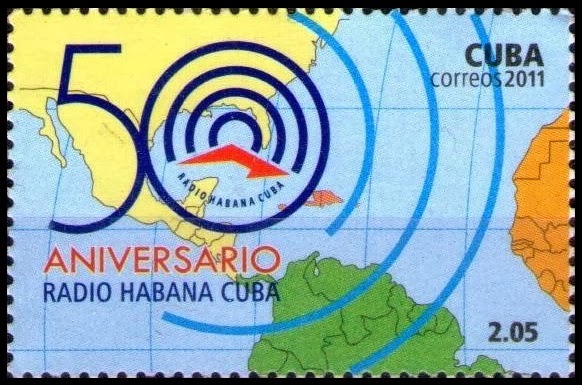
Radio Habana Cuba: September 13, 2013

Radio Habana Cuba recorded in London, UK on September 13, 2013 at 0232 UTC on the frequency of 6060 kHz using a Tecsun PL380 portable radio with a 4 meter clip-on long wire antenna extension. The transmitter is located in Bauta, Cuba and has a power rating of 100 kW. This broadcast was a relay of Radio Rebelde's live coverage of the Cuban Artists' "Concert for the Five" that took place at Havana Jose Marti Anti-Imperialist Plaza. "The Five" referred to the four Cuban nationals remaining in US custody of the five originally imprisoned in the US in the early 2000s. They were released on December 18, 2014 in exchange for the freeing of Alan Gross by the Cuban authorities, as part of a deal that marked the beginning of the restoration of the US-Cuban relations.

Radio Damascus, Syria: October 23, 2013

Radio Damascus, Syria recorded in Moscow, Russia on October 23, 2013 at 2242 UTC on the frequency of 783 kHz using a Tecsun PL380 portable radio. The transmitter is located in Tartus, Syria and has a power rating of 600 kW. This is a local service targeted at the domestic audience. There were several short poor propagation spells throughout the recording, after which the signal would recover.

BBC Radio 4, The Shipping Forecast: September 29, 2015

Many thanks to SRAA contributor, Richard Langley, who notes:

Live recording of the Shipping Forecast broadcast by BBC Radio 4 Longwave on 29 September 2015 beginning at 23:46 UTC on a frequency of 198 kHz from the 500 kW transmitter at Droitwich, near Worcester, England. 
Reception was fairly good with slight co-channel interference and some static. The recording includes "Sailing By," the introductory music for the late-night version of the Shipping Forecast. The recording ends with the national anthem ("God Save the Queen") signalling the end of the broadcast day for Radio 4, and the Greenwich Time Signal (the Six Pips). 
The broadcast was received by the Web-interface wideband software-defined radio at the University of Twente in Enschede, The Netherlands, with a "Mini-Whip" antenna in AM mode with 8.09 kHz RF filtering.

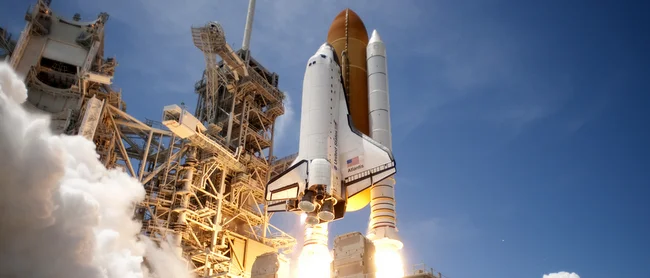
Radio Spaceshuttle International: September 20, 2015

Many thanks to SRAA contributor, Richard Langley, who notes:

Live hour-long recording of the "last" Radio Spaceshuttle International broadcast on 20 September 2015 beginning at 19:00 UTC on a frequency of 13600 kHz. The broadcast was from the Kostinbrod (near Sofia), Bulgaria, transmitter site. The transmitter power announced during the broadcast was 100 kW. This is consistent with the HFCC (High Frequency Coordination Conference) registration of the 13600 kHz frequency by Spaceline, Ltd., the airtime broker for shortwave transmissions from Kostinbrod, between 10:00 and 20:00 UTC. The registered antenna beam direction is 195 degrees.
Reception was poor to fair with some interference from Radio Martí on 13605 kHz and the Cuban jammer aimed at it. The broadcast, compered by "Dick Spacewalker" and originating in Finland, consisted of pop music and acknowledgements of listeners' reports. The language used is mostly English with some Finnish and Japanese announcements. The broadcast begins anomalously at 19:00:11 UTC with a sign-on announcement from the Overcomer Ministry (also a user of the Kostinbrod facility) and a wrong announced frequency. The Radio Spaceshuttle International program begins about 1m:20s later. 
The broadcast was received on a Tecsun PL-880 receiver with a Tecsun AN-03L 7-metre wire antenna outdoors in Hanwell (just outside Fredericton), New Brunswick, Canada, in AM mode with 3.5 kHz RF filtering. 

The Mighty KBC: September 26, 2015

Many thanks to SRAA contributor, Richard Langley, who notes:

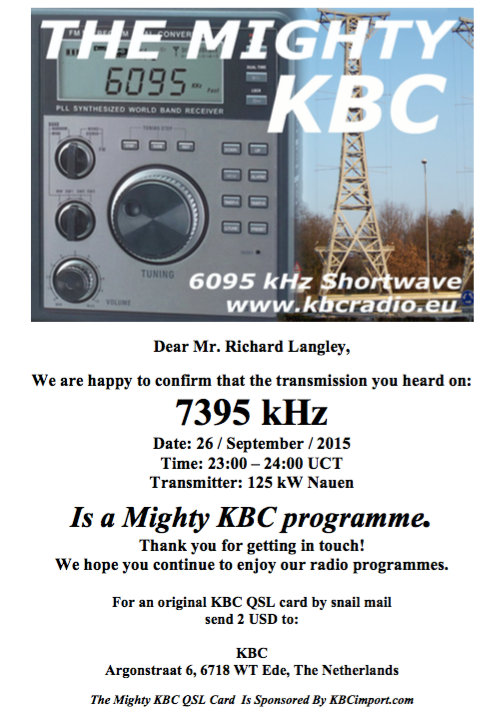
Live hour-long recording of a test transmission from the The Mighty KBC on 26 September 2015 beginning at 23:00 UTC on a frequency of 7395 kHz, likely from a transmitter site in Europe. The Mighty KBC uses a transmitter at Nauen, Germany, operating at 125 kW for its regular Sunday UTC broadcast.
Reception was very good with negligible interference and only slight fading. The program ("The Giant Jukebox"), produced and announced by Eric van Willegen ("Uncle Eric") originated from Ede, The Netherlands, and consisted of pop music and announcements including requests for reception reports.
The broadcast was received on a Tecsun PL-880 receiver with its built-in telescopic whip antenna indoors in Hanwell (just outside Fredericton), New Brunswick, Canada, in AM mode with 5.0 kHz RF filtering. 

KCBS Pyongyang: September 17, 2015

Korean Central Broadcasting Station, Pyongyang recorded in London, UK on September 17, 2015 at 1605 UTC, on the frequency of 9665 kHz using SDRPlay with SDR# software and a 2 x 6m long wire dipole. The non-directional transmitter has a power rating of 50 kW and is located in Kanggye, DPRK. From NorthKoreaTech:

The Korean Central Broadcasting Station (KCBS) (Korean: 조선중앙방송, Chinese: 朝鲜中央放送, Japanese: 朝鮮中央放送) is the main domestic radio network in the DPRK. It sits under the Central Broadcasting Committee of the DPRK (called the Radio and Television Committee of the DPRK until 2009).
KCBS broadcasts from 5am to 3am local time via a network of mediumwave and shortwave transmitters that cover the nation. The powerful transmissions can easily be heard in neighboring countries, including South Korea where some of its frequencies are jammed.
A central program is broadcast from Pyongyang on most transmitters through the entire broadcast day, but some are reported to carry regional programming between 2pm and 3pm.
All programming is in Korean and includes music, talk and news.

The station appears to be a difficult catch in Europe because of the relatively low power and the non-directional mode of the transmission, and because of frequency clashes with China Radio International, Radio Cairo and Radio Voz Missionaria of Brazil. Indeed this recording was made in the small time window between CRI's Pashto and Hausa broadcasts, the latter of which can be heard starting at the end of the recording.

Furusato No Kaze: September 17, 2015

Furusato No Kaze recorded in London, UK on September 17, 2015 at 1600 UTC, on the frequency of 9960 kHz using SDRPlay with SDR# software and a 2 x 6m long wire dipole. The transmitter has a power rating of 100 kW and is located in Palau. From NorthKoreaTech:

Shortwave radio remains a vitally important way to reach into North Korea because of the total lack of international communications offered to its citizens. 
Furusato no Kaze (ふるさとの風, Hometown Wind) is run by the Japanese government and targets any Japanese citizens that were abducted by North Korea and remain alive in the country. There are two programs: Furusato no Kaze in Japanese and Nippon no Kaze (il bon ue baram, Japan Wind) in Korean. The first and last broadcasts of each day come from transmitters in Taiwan while the rest are from Palau.

You can also hear what appear to be North Korean jamming attempts in the background.

RCI, VOA, and BBC: 1979 and 1981

Many thanks to SRAA contributor, Tom Laskowski, who shares the following recordings and notes:

A few snippets from my old shortwave tapes that were too short to upload individually. These were made using a GE portable multi band that had poor selectivity, hence the annoying ute during the BBC clip.
Times of individual clips are:
00:00 - 01:59: 1979, July 19 - RCI, frequency announcements in English and french.
01:59 - 09:51: 1979, July 20 - BBC, newscast, bothered by an annoying utility station.
09:51 - 11:38: 1981, August 28 - VOA, science news item about Voyager 2
11:38 - 14:52: 1981, August 29 - VOA, science news item about Voyager 2

Radio Spaceshuttle International: September 20, 2015

SRAA contributor, Jim Clary (ND9M/VQ9JC), recorded the following final broadcast of Radio Spaceshuttle International while on board a US Navy ship off the coast of Spain. Jim notes:

I was packing up to leave my ship and return to the USA this week when the latest SWLing Post e-mail showed up with info about SSR's final broadcast literally seven minutes before he was to come on the air. I'd already broken down the receiving gear, but it came back together in record time, and I was able to get the recorder going with a minute before the transmission started.
 
SSR's signal was a solid S9, which wasn't all that surprising since he's only a few hundred miles from here. 

Deutsche Welle in English, satellite recording: July 4, 1996

This recording is not exactly shortwave broadcast, but was made in Europe from the satellite transmission of Deutsche Welle in English broadcast on 4 July 1996 at 2000 GMT. During that time DW was offering extensive service for Europe with many interesting entries. Programmes were also transmitted over the shortwave (by the way: it is interesting that the frequency announced with regard to 41mb is now, in 2015, beyond the allowed band)

Radio Saudi Internationale in French: September 17, 2015

Radio Saudi Internationale in French recorded in Europe at 1400 GMT on September 17, 2015 off the shortwave frequency of 17660 kHz (transmitter site: Riyadh in the Kingdom of Saudi Arabia; transmitter power: 500 kW, beamed towards West Africa). Recording starts with around 1-minute constant sound tone, followed by station's interval signal (bird songs) and station's ID

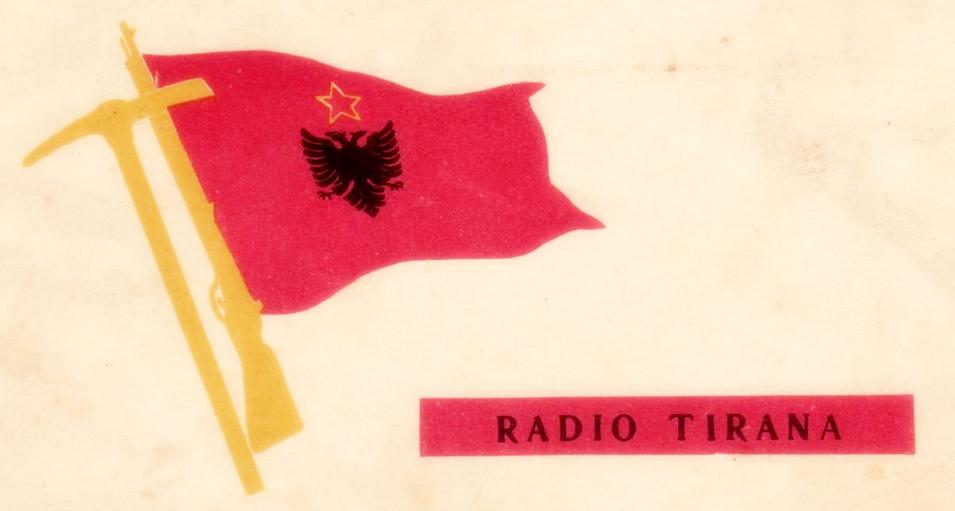
Radio Tirana: September 17, 2015

For your listening pleasure: Radio Tirana's English language service.

This recording was made on September 16, 2015 at 01:30 UTC on 9580 kHz. The receiver used was an Elad FDM-S2 hooked up to a large horizontal delta loop antenna in the southeast USA. The Tirana signal is weak--and conditions quite noisy--but still quite audible.

Radio Biafra: September 4, 2015

On September 4, 2015, I received a tip from SWLing Post contributor, Dan Robinson: Radio Biafra, a new clandestine station, was audible on 15,560 kHz via the Universite Twente Web SDR.

Despite miserable propagation conditions, I tuned my receiver to 15,560 kHz and was surprised to hear a weak signal from Radio Biafra, here in the eastern US. I recorded a few minutes before conditions changed and Biafra’s signal began to fade.

This was the first time I had logged Radio Biafra, so I was amazed to have copy clear enough to understand.

Wikipedia has a short entry for Radio Biafra:

Radio Biafra also known as Voice of Biafra, is a radio station that was originally founded by the government of the Republic of Biafra but is currently operated by Mazi Nnamdi Kanu. Believed to have had its first transmission before the Nigeria-Biafra war, the radio station was instrumental in the broadcast of speeches and propaganda by Chukwuemeka Odumegwu Ojukwu to the people of the Republic of Biafra.

[…]Radio Biafra currently transmits via the internet and shortwave broadcast targeted majorly around Eastern Nigeria. Radio Biafra claims to be broadcasting the ideology of Biafra –”Freedom of the Biafra people”.

[…]Radio Biafra has been met with mixed reactions. While some critics have criticized the station for “inciting war” through its programmes and “preaching hate messages” against Nigeria which it refers to as a “zoo”, an editor for Sahara Reporters wrote in defence of the radio station after he compared Radio Biafra with the British Broadcasting Corporation Hausa service.

On 14 July 2015, it was reported in the media that the radio station had been jammed because it did not have a broadcast license from the Nigerian Broadcasting Commission. However, the radio station in a swift reaction labelled such claims as “lies” and went on to release its new frequency details to the public.

Note that the Wikipedia entry for Radio Biafra is rather new, having only been created in August, 2015.

The following short recording was made using my WinRadio Excalibur hooked up to a large skyloop antenna:
This two hour recording, by Dan Robinson, was made via the Universite Twente Web SDR in the Netherlands: