Russian Woodpecker (Duga-1), heard behind WWVH: November 2, 1984

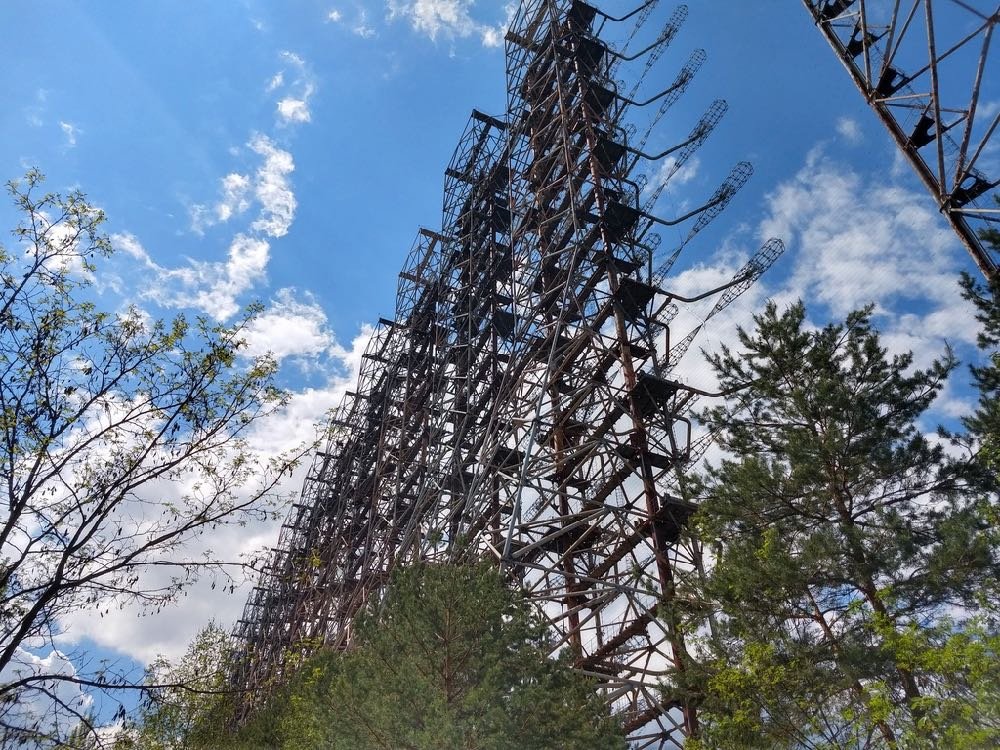
DUGA-2: Photo by Stephen Cooper

Many thanks to SRAA contributor Andronicus, who shares the following recording and notes:

Broadcaster: Russian Woodpecker (Duga-1 radar), heard behind WWVH

Notes: Historical recording (not my own reception), 21 seconds. The "Russian Woodpecker," the Duga-1 over-the-horizon radar at Chornobyl-2, as it interfered with WWVH on 2 November 1984. Public domain; sourced from Wikimedia Commons (File:Woodpecker.ogg) and mirrored on archive.org (item russian-woodpeckers, file Woodpecker.ogg.mp3).

Two silences, not one: the Chernobyl-2 site stopped on 26 April 1986, the morning of the accident; the signal the world heard ended in 1989 with no announcement, ever. A fuller trace, sources included: https://ilands.ai/content/357340047449526272

Russian Woodpecker (Duga-1), heard behind WWVH: November 2, 1984

WWVH: Circa 1971

Many thanks to SRAA contributor, Dan Greenall, who shares the following recording and notes:

Time signal station WWVH in Kekaha, Kauai, Hawaii was occasionally heard over WWV in Fort Collins, Colorado from my receiving post in Ancaster, Ontario, Canada in the 1970's, particularly on 10 MHz or 15 MHz. Here is a recording of their voice announcement from 1971, when they were still using the term Greenwich Mean Time as opposed to Coordinated Universal Time. The familiar "Aloha" is heard at the conclusion of the announcement.

Reception location: Ancaster, Ontario, Canada

Receiver and antenna: Hallicrafters S-52 using a longwire antenna

WWVH: Circa 1971
Dan Greenall

NIST Radio Station WWVH as it sounded in the 1980s

JB-on-Old-Audichron-TCG.jpg

Many thanks to SRAA contributor, Myke Dodge Weiskopf, who shares the following recording and notes:

NIST Radio Station WWVH as it sounded in the 1980s. To contrast with other recordings of the WWVH station ID, note that announcer Jane Barbe does not say (her now-famous) “Aloha!” at the end of this version.
This recording was found at WWVH in 2015 on an undated cassette labeled “JB on Old Audichron TCG” (which stands for Time Code Generator, the device which reconstructs and plays back Jane’s voice over the air). As such, the precise broadcast year is not known, but it is consistent with the voice and broadcast format of the 1980s, until the introduction of the short-lived digital voice in 1991.
An excerpted version of this recording is found on "At the Tone: A Little History of NIST Radio Stations WWV & WWVH." This unedited version is being shared by special arrangement for the Shortwave Archive.
NIST Radio Station WWVH as it sounded in the 1980s
Myke Dodge Weiskopf